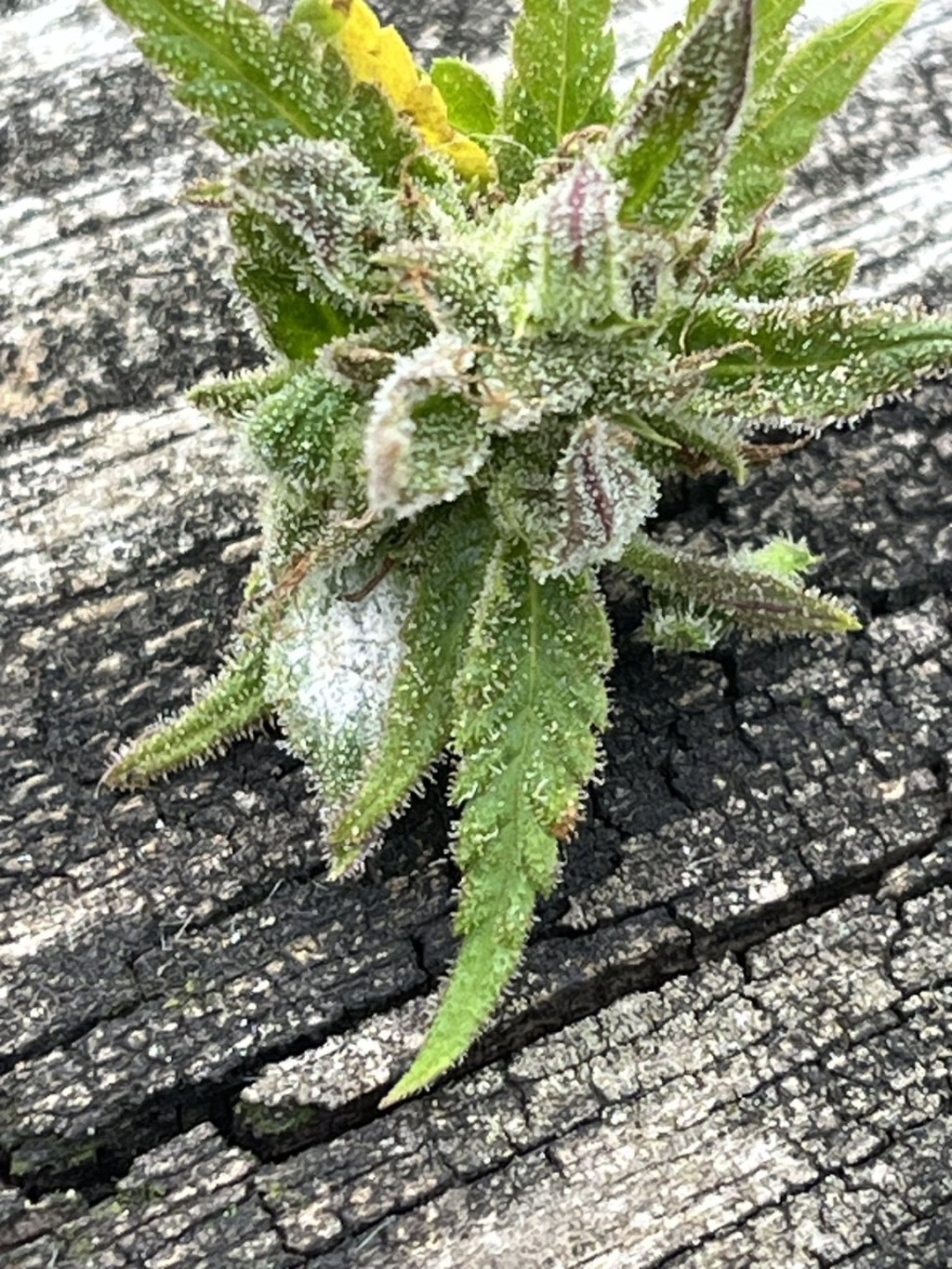
If you grow outdoors anywhere humid, you’re going to meet powdery mildew sooner or later. Here in the Ohio Valley, humidity ran 80 to 95% almost the whole summer. Even with a routine I stuck to, I still had PM start on a couple of plants. I caught it early both times and kept it under control, and I learned a lot doing it.
Here’s what I do, what I’d tell a friend, and where the research backs me up and where it doesn’t.
Know what you’re looking at
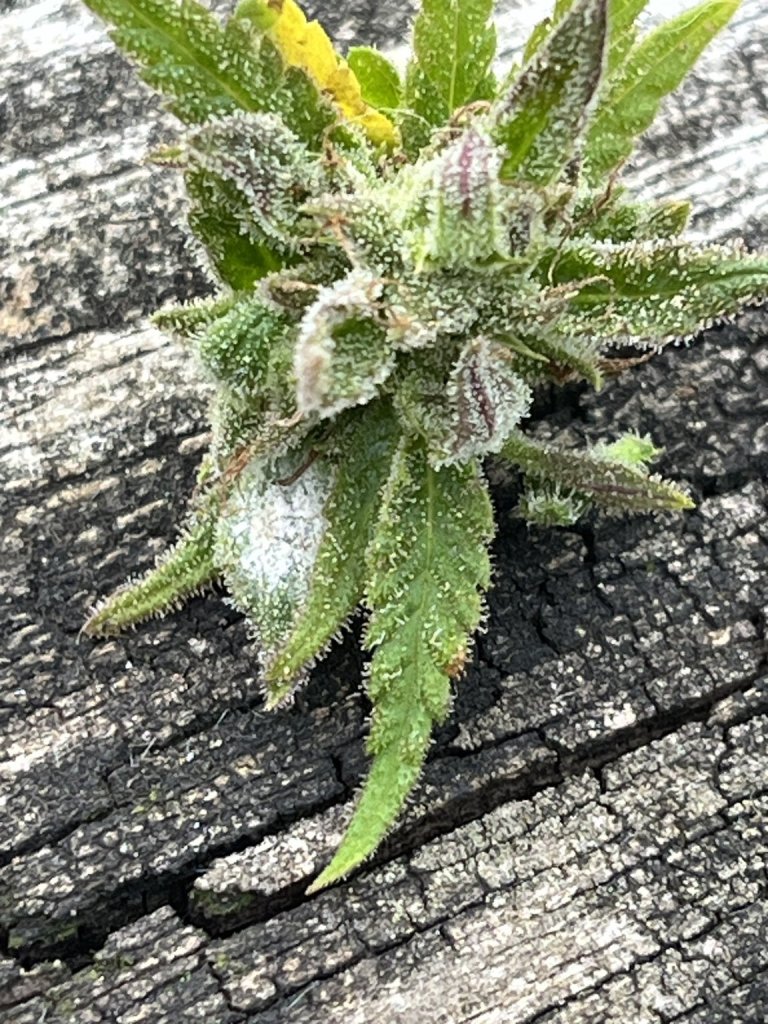
PM looks like someone dusted white flour on your leaves. It usually shows up first as small white, powdery spots on the lower, shady leaves, and it spreads from there. Don’t confuse it with trichomes, which are shiny and sit on the buds and sugar leaves. PM is flat, dull and powdery, and it shows up on the fan leaves too.
Something that surprises a lot of people: rain on its own isn’t what drives PM. It loves humidity, shade and still air. Rain soaking into dense buds is what brings bud rot, and that’s a different disease that needs its own plan. [1]
Start with the right plant
Genetics matter more than anything you spray. In side-by-side comparisons, researchers found some cannabis cultivars get PM much worse than others. [1] Another team found a single gene, called PM1, that gave complete resistance to one strain of PM. [2] That doesn’t make any plant immune, but it does mean it’s worth asking breeders how a strain held up in humid weather, and asking growers near you what made it through this year.
Give it nowhere to hide
- Space your plants out. Air needs to move between them, and leaves need to dry fast.
- Open up the middle. I train low and wide with LST, which opens the center of the plant to light and air.
- Clean up the bottom. I take off the growth in roughly the bottom 12 to 16 inches of my plants. That’s the shady, still part of the plant where PM likes to start.
- Keep the weeds down. PM is picky about its hosts. The main one on cannabis is most often reported on plants in the daisy family, which includes ragweed. The PM you usually see on cucumbers is a different species, so your garden veggies may not be the source. [1]
- Move the air. When my plants are in the garage, I run an oscillating fan on medium around the clock.
Prevent early, not after you see it
The time to start is in veg, before you ever see a spot. Once PM is everywhere, you’re playing catch-up. In greenhouse trials at Simon Fraser University, several biological and mineral-based products reduced PM, including ones based on potassium bicarbonate and Bacillus subtilis. [3] That was a greenhouse, not an outdoor garden, and it doesn’t mean any product is labeled for your use where you live, so check the label first.
Here’s what I used this season. It’s not a schedule to copy, and each product’s label decides what it can go on, how often, and how close to harvest:
- Athena IPM in veg, starting about week three.
- Lost Coast Plant Therapy or Grow Safe in flower. Both are safe to use on flowers.
- Southern Ag Garden Friendly Fungicide as a root drench, to try to build up the plant’s own defenses even further.
- A silica supplement this season to help strengthen the plants. I can’t say it prevented anything, since I didn’t grow plants without it to compare.
I haven’t tested whether any of these prevents PM. I can only tell you I used them and kept it under control. A 2024 review of cannabis disease research came to the same conclusion I did: no single thing is enough. It takes the right genetics, clean plants, good watering habits, scouting and airflow, all together. [4]
Scout like it’s your job
Check every few days. Flip the leaves over, and start with the low, shady ones on the inside, because that’s where it shows up first. The earlier you catch it, the easier it is. Two spots are a quick fix. A whole plant is a problem.
Free printable: Spot Mildew and Bud Rot Early
The earlier you catch it, the more bud you save. This two-page guide shows what early powdery mildew looks like on one of my own buds, the first signs of bud rot and Septoria, where to look on every scouting walk, and exactly what I do the day I find it, plus a scouting log. Enter your email, confirm it, and the link arrives in your inbox along with all my other free printables.
After you sign up, check your inbox for an email from WordPress.com and tap Confirm. Your printables arrive right after. Don’t see it? Check your spam or Promotions folder. One newsletter a month, unsubscribe anytime. See all the printables
When you find it
- Pull the leaf the day you find it. Bag it right there at the plant so you’re not shaking spores all over everything, and toss it in the trash.
- If it’s on a bud, the whole bud goes. If I see even the smallest amount of PM on a bud, I remove the entire bud. I don’t try to pick it clean or save part of it. It gets bagged at the plant and trashed just like the leaves.
- Wipe your shears before you touch the next plant.
- Treat it. When I had an outbreak, I did a light blanket spray of Lost Coast, only about a tenth of a gallon so it would dry fast, at 11 at night in full darkness. Follow your label on how often you can spray.
- Keep checking. Getting rid of the spots you can see doesn’t mean it’s gone.
What about home remedies?
Everybody’s got one. Here’s what the research actually says about the common ones:
- Potassium bicarbonate is the one with real evidence. It’s a cousin of baking soda. In organic greenhouse trials on crops like tomato, cucumber and melon, it cut powdery mildew by more than 90% when it was sprayed before PM showed up, about as well as sulfur, with no leaf damage. It worked less well, about 74%, on melons that already had PM. [5] The Simon Fraser trials on cannabis found it reduced PM too. [3] It’s sold as a labeled fungicide, so buy a product made for it and follow the label instead of mixing your own.
- Baking soda is iffy. It can slow PM down, but it doesn’t kill it. In the field the results are hit or miss, rain washes it off, and the stronger mixes it takes to work outside can burn leaves because of the sodium. A Washington State University extension expert concluded it isn’t likely to control fungal disease in your garden. [6] University of Wisconsin Extension says baking soda mixed with oil is the one homemade mix that shows some promise. [7]
- Milk, vinegar, hydrogen peroxide, garlic and compost tea are all on University of Wisconsin Extension’s list of home remedies that don’t hold up. [7]
One more thing to keep in mind: whatever you spray on a cannabis plant can end up on something you smoke. Products labeled to go on flowers are the safer bet, and homemade mixes should stay off the buds.
What happened in my garden
My Heka indica pheno got some PM. I threw away the one cola it got to and sprayed Lost Coast twice a week, and that kept it under control. Late in flower it started trying to get ahead of me again, so I chopped her on October 18, at the beginning of her peak potency window. The tops were fully mature and all the hairs had receded on the middle and lower buds, so there was no reason to give the PM more time. Losing that cola cost me roughly 10% of her weight, and she still gave me 5.5 ounces dry.
My first Durban Cake showed one or two tiny spots of what looked like PM just starting. It was close to done anyway, so I harvested before it could spread or become a problem.
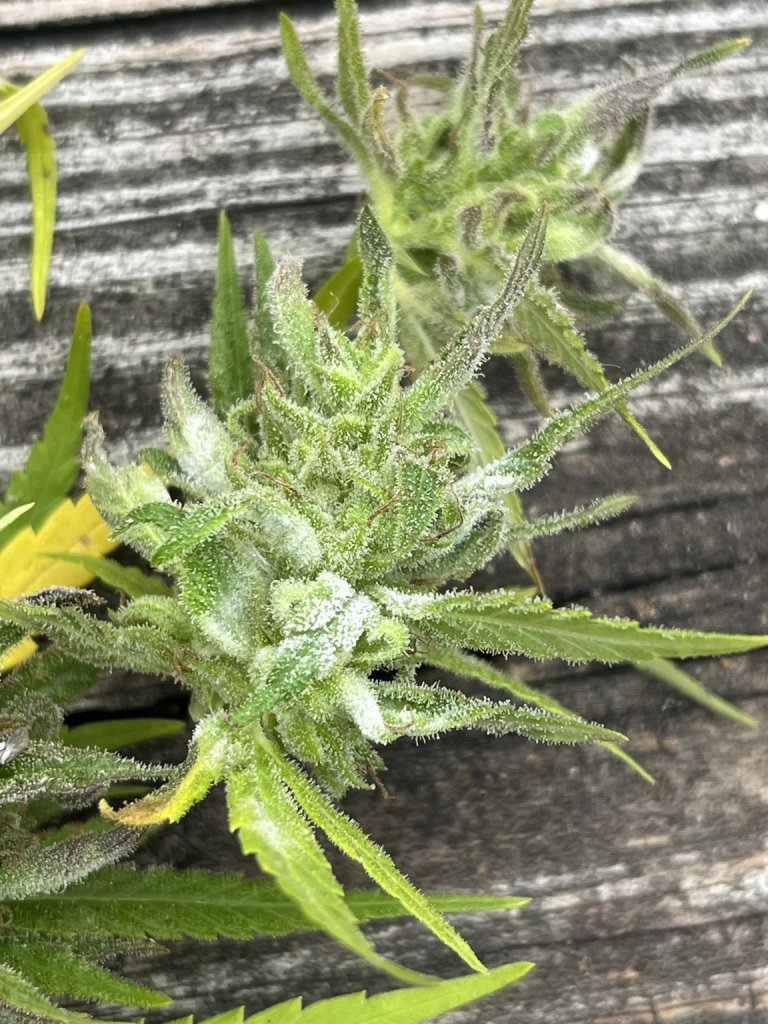
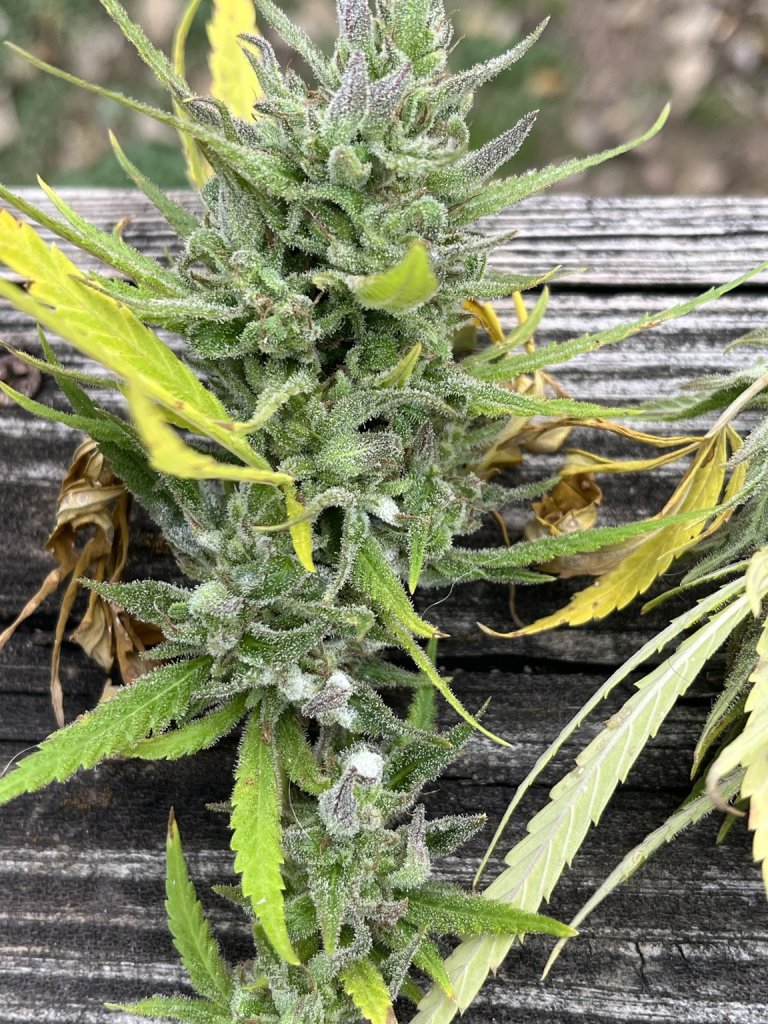
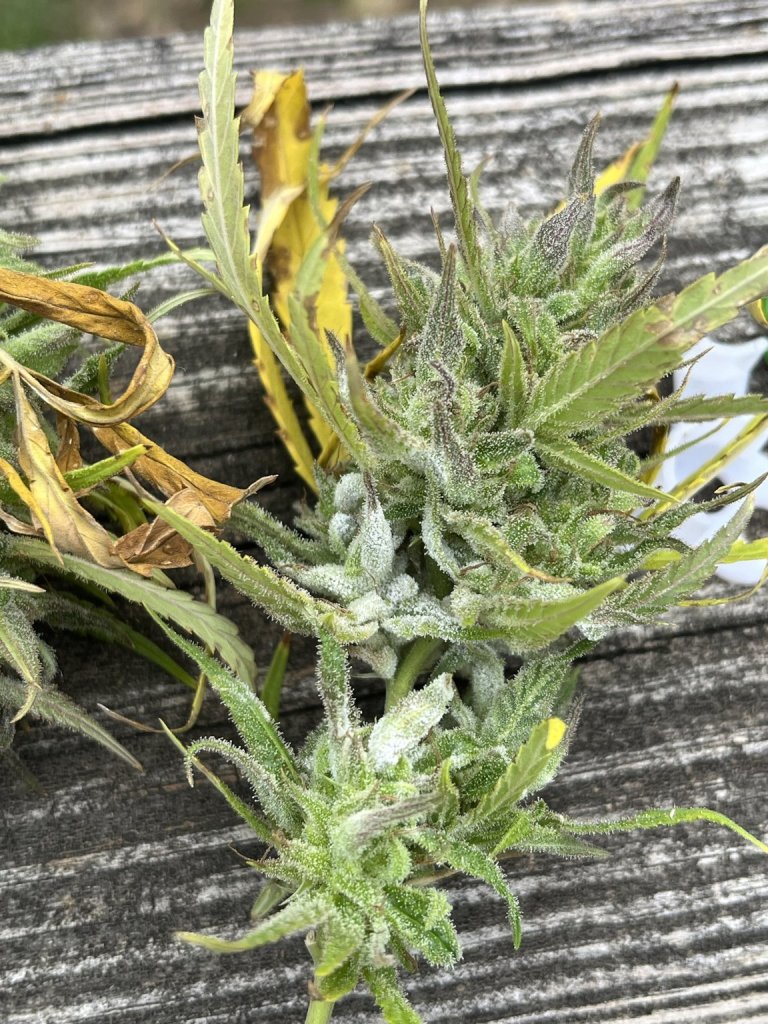
That’s the call you sometimes have to make. If PM is getting ahead of you late in flower and the plant is already ready, there’s no reason to push her for more time.
The rules I always follow
How often you spray and how close to harvest is always the label’s call. No spray makes mildewed bud safe to smoke. And any bud with even a little PM on it comes off whole and goes in the trash.
If you want all of this on paper, my free Bud Rot & Mildew Prevention Checklist has it on two printable pages with a scouting log. And my full pest routine, with sources, is in Outdoor Pest & Disease Prevention.
Sources
[1] Scott C, Punja ZK. How can powdery mildew on cannabis be managed? Greenhouse Canada. 2022. greenhousecanada.com
[2] Mihalyov PD, Garfinkel AR. Discovery and genetic mapping of PM1, a powdery mildew resistance gene in Cannabis sativa L. Frontiers in Agronomy. 2021;3:720215. doi:10.3389/fagro.2021.720215
[3] Simon Fraser University thesis, Department of Biological Sciences (Punja lab): management of diseases on cannabis in controlled environments, including powdery mildew treatments. Read the thesis (PDF)
[4] Buirs L, Punja ZK. Integrated management of pathogens and microbes in Cannabis sativa L. (cannabis) under greenhouse conditions. Plants. 2024;13(6):786. doi:10.3390/plants13060786
[5] Koller M. Potassium bicarbonate as a fungicide against powdery mildew in organic greenhouse crops. Acta Horticulturae. 2011;915:157-163. ishs.org
[6] Chalker-Scott L. Baking soda. Washington State University, Puyallup Research and Extension Center. 2009. Read the fact sheet (PDF)
[7] University of Wisconsin-Madison Extension. Powdery mildew home remedies. hort.extension.wisc.edu
This is my own experience from one season in southern Ohio, not a tested result. Always follow product labels and your local laws.


Leave a Reply